
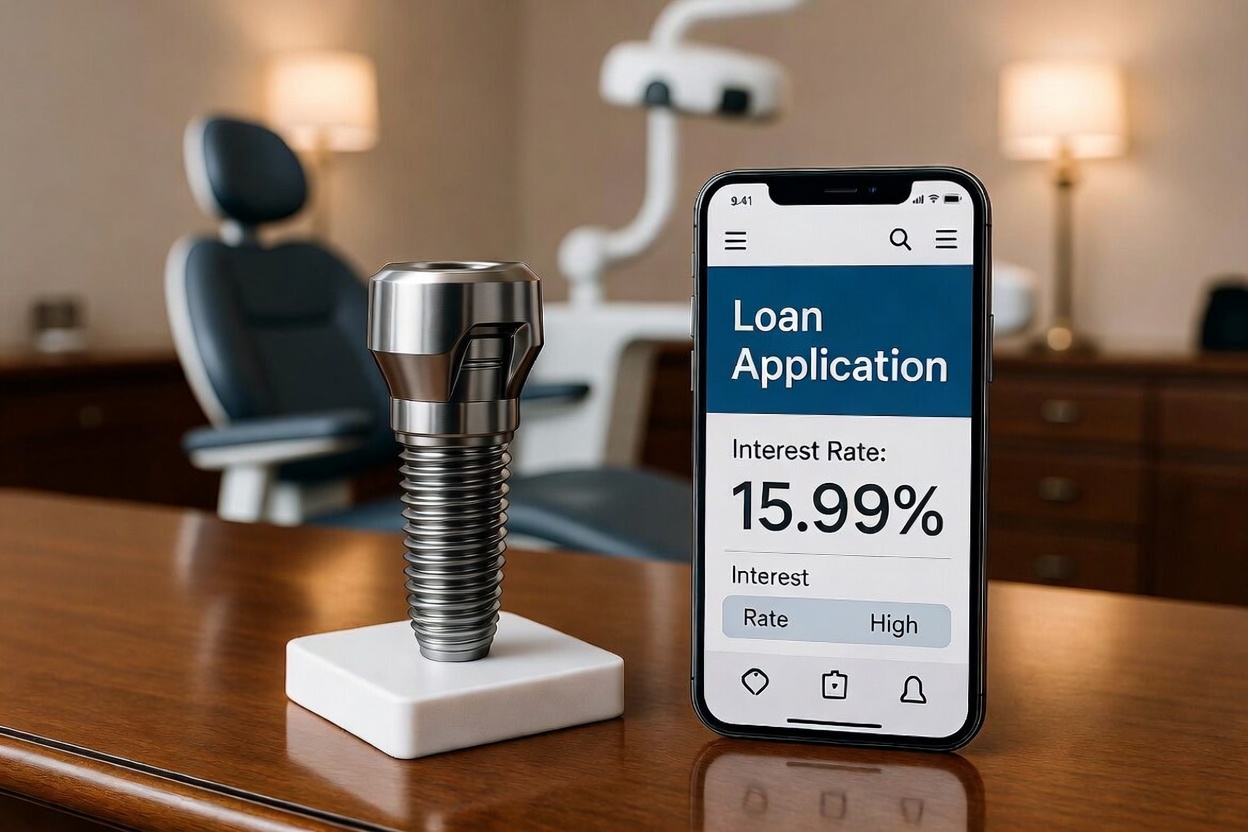
[Story Summary]
- High borrowing costs and inflation are forcing patients to delay elective dental procedures, transforming clinical decisions into complex capital-allocation choices.
- The story suggests that as consumer confidence fluctuates and interest rates remain high, patient "sticker shock" is shifting from the total procedure price to the monthly financing cost, likely dampening mid-term consumer spending on high-ticket dental items.
- The dental sector is facing a "squeeze" where laboratory and material costs are rising (e.g., a 12–18% increase in implant material costs due to 2025 tariffs), while insurance reimbursements remain stagnant and patient conversion rates for elective work decline (Taylor & Francis, 2026).
[What it means for practice owners]
- Conversion Pressure: Expect a continued decline in same-day acceptance for cases exceeding $1,500; the gap between diagnosis and treatment is widening as patients prioritize "needs" over "wants" in a high-interest environment.
- Margin Erosion: With material costs for implants rising by 12–18% since 2025 and dentists' net income having fallen by approximately 27% since 2000 (adjusted for inflation), owners must optimize overhead or risk significant profitability drops (Taylor & Francis, 2025, 2026).
- Financing Strategy: Reliance on high-interest third-party lenders may become a liability; successful practices are pivoting to "value framing" and transparent, predictable internal payment structures to combat the "bridge too far" psychology of current credit terms.
[Story]
The Sticker Price Meets the Monthly Payment
Dental implants have long carried a reputation as one of dentistry’s most transformative—and expensive—procedures. A single-tooth implant typically runs between $3,000 and $7,000, according to multiple industry analyses conducted between 2023 and 2026. Full-arch restorations can climb into the $15,000-to-$50,000 range. Insurance coverage remains spotty; many plans treat implants as elective or cosmetic, leaving patients responsible for the bulk of the tab. For years, the solution was straightforward: third-party financing turned a five-figure ask into manageable monthly installments. But beginning in 2022, the Federal Reserve’s aggressive rate hikes altered that equation. What once felt like an accessible stretch became, for many patients, a bridge too far.
Financing’s New Arithmetic
CareCredit, the dominant player in healthcare consumer financing, illustrates the shift. Its promotional offers—six to 24 months of “no interest if paid in full”—rely on deferred-interest mechanics. Miss the payoff window by even a day, and the full 32.99 percent APR (as of mid-2024) applies retroactively to the entire original balance. Longer-term fixed-payment options carry reduced but still elevated rates: 17.90 percent for 24 months on purchases over $1,000, scaling to 20.90 percent for 60-month terms on purchases over $2,500. These rates were set against a backdrop of historically low borrowing costs before 2022. When the Fed pushed its benchmark rate above 5 percent, the broader consumer-credit environment tightened. Alternative lenders and personal-loan products followed suit, pushing effective monthly payments higher even for patients who qualified for promotions.
A $5,000 implant financed over 18 months under a promotional plan might have required roughly $278 a month before rates climbed. Add the risk of deferred interest or a shift to standard terms, and the same procedure now carries a heavier psychological weight. Practices that once saw financing as a reliable closer report that patients now scrutinize the fine print more closely—or simply walk away. Industry observers note that financing programs still boost acceptance for cases over $1,500 by 20 to 30 percent when offered, but the baseline hesitation has grown.
The Elective Patient’s Calculus
Implants sit squarely in the elective category. Unlike emergency extractions or pain-driven root canals, they address function and aesthetics that patients can, and often do, postpone. Dental Economics and practice-management consultants have documented the pattern for years: when the out-of-pocket burden exceeds roughly $1,500—even with partial insurance—acceptance rates drop sharply. For implants specifically, acceptance hovers between 60 and 70 percent in high-performing offices, according to 2025 benchmarks, but overall treatment-plan acceptance by dollar value across practices lands closer to 35–45 percent.
Higher capital costs amplify this sensitivity. Patients weighing a new smile against car payments, mortgages, or college tuition now face a starker trade-off. CareCredit’s own provider resources acknowledged the pressure in late 2024: “with rising interest rates, inflation impacting everyday goods and services and rising healthcare costs, health and wellness patients…have even more hurdles to overcome.” The message was aimed at practices, but it reflected the reality patients were living. Delaying treatment became the default strategy for many who could not comfortably absorb an extra $50 or $100 a month.
What the Numbers Reveal
The American Dental Association’s Health Policy Institute tracks the broader picture. Consumer dental spending rose a modest 3 percent year-to-date through May 2025 and 8 percent above pre-pandemic levels when adjusted for inflation. Yet that growth lags far behind overall health-care spending (up 20 percent) and physician services (up 22 percent). Dentist confidence in the U.S. economy hit new lows in the second quarter of 2025, with only 56.3 percent expressing optimism—down sharply from prior quarters. Reimbursement rates for dental services have increased but failed to keep pace with inflation, squeezing practices while patients feel the pinch at the financing counter.
Equipment and supply prices climbed 5 percent in early 2025 alone, adding overhead pressure that some practices pass along indirectly. Meanwhile, new-patient wait times remained stable at roughly 13 days, suggesting demand exists—but conversion from diagnosis to accepted treatment does not. High-cost elective work, including implants, appears to be where the disconnect is most pronounced.
Practices on the Front Line
Dentists and their teams have responded with familiar tactics: clearer financial discussions, in-house payment plans, and partnerships with newer fintech lenders offering simpler interest structures. Some have shifted emphasis to “value framing”—highlighting how implants prevent future bone loss and more expensive interventions—while others have introduced sliding-scale or shorter-term options. Yet the data suggest these adaptations have not fully offset the macroeconomic headwind. Practices that once closed 70 percent of implant cases now report more “let me think about it” responses, particularly among middle-income patients who previously qualified for promotional financing but now balk at the effective cost of capital.
The Lasting Reckoning
The convergence of elevated borrowing costs and elective dentistry’s price sensitivity has exposed a quiet truth: implants are no longer just a clinical decision. They have become a capital-allocation choice for patients who must weigh oral health against every other financial priority. As long as interest rates remain above the ultra-low levels of the previous decade, the psychology of the elective dental patient will favor delay over commitment. The practices that thrive will be those that make financing transparent, predictable, and genuinely affordable—not merely available. For the broader profession, the episode underscores a deeper vulnerability: when capital costs rise, even the most life-changing procedures can become luxuries patients learn to live without.
**Sources**
• American Dental Association Health Policy Institute, “State of the U.S. Dental Economy Q2 2025,” May 2025 (consumer spending and dentist confidence data).
• CareCredit Provider Insights, “Costs Are Critical in the Patient Journey,” November 2024 (acknowledgment of rising interest rates and inflation hurdles).
• Dental Economics and practice-management reports citing 20–30 percent acceptance lift from financing for cases >$1,500, 2023–2025.
• Multiple clinical and industry analyses, 2023–2026, documenting single-implant costs of $3,000–$7,000 and full-arch ranges.
• Synchrony Bank CareCredit terms (32.99 percent standard APR, deferred-interest mechanics), current as of 2024–2025 disclosures.