
[Story Summary]
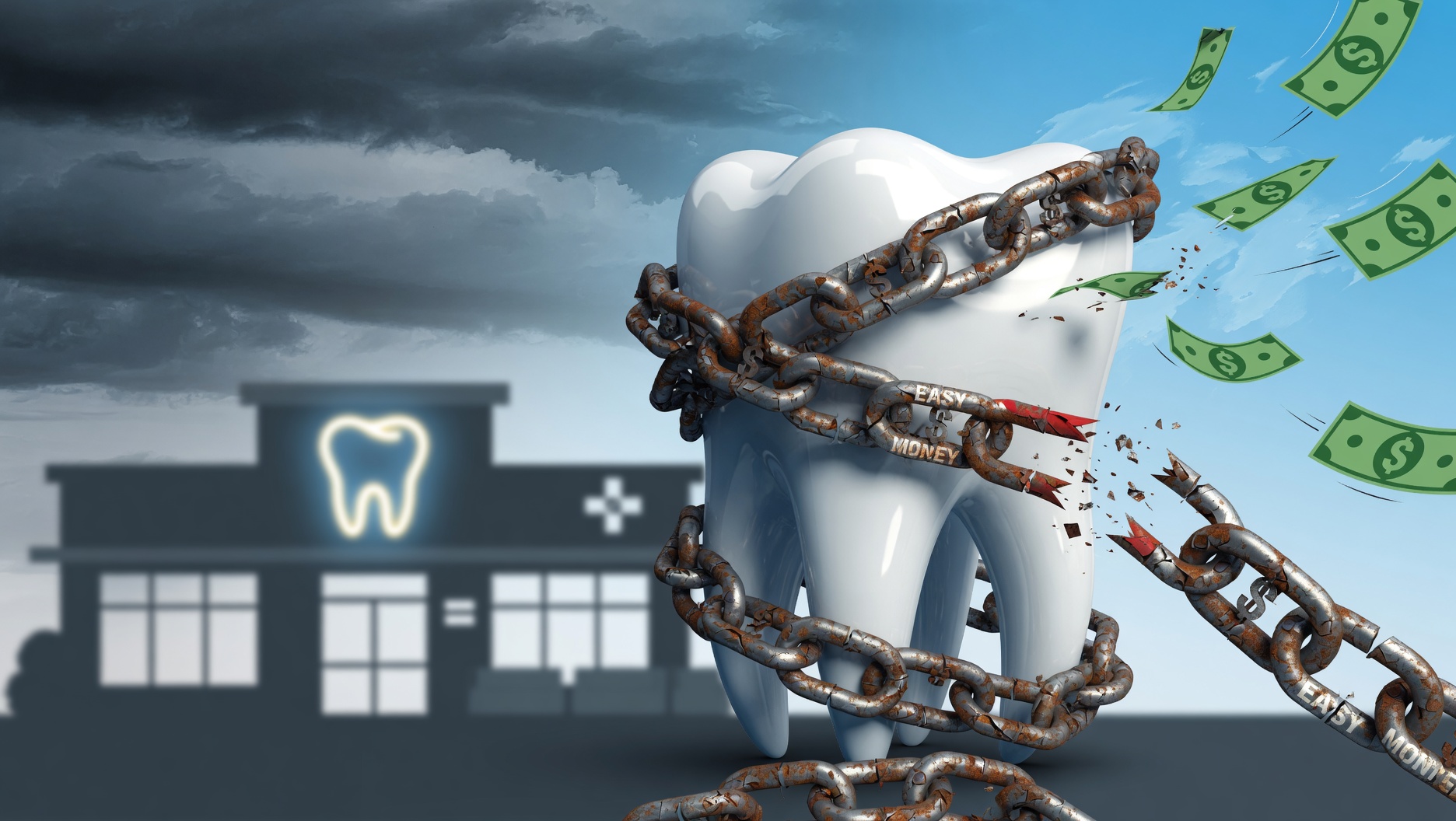
- The April 2026 debt restructurings of Dental Care Alliance (DCA) and Affordable Care signal a definitive shift in the dental industry from a model of debt-fueled rapid consolidation to one of operational discipline and balance-sheet stability.
- High interest rates and persistent inflation have cooled consumer confidence, leading to a noticeable softening in demand for high-ticket elective services as patients prioritize essential care over discretionary procedures.
- The healthcare sector, particularly the DSO space, is moving away from the "financial engineering" era; future valuations will be driven by organic growth, clinical efficiency, and sustainable cash flow rather than simple arbitrage on acquisition multiples.
[What it means for practice owners]
- Compressed Exit Multiples: The "gold rush" valuations of 8X+ EBITDA have largely corrected. Independent owners should expect offers in the 4–6X range, with a higher emphasis on earn-outs and performance-based rollover equity.
- Elective Care Headwinds: Consumers are increasingly price-sensitive regarding implants, full-arch restorations, and clear aligners. Practices must refine their internal financing options (e.g., PatientFi, CareCredit) and case presentation strategies to maintain volume in these high-margin areas.
- Operational Scrutiny: DSOs and private buyers are no longer buying "potential"; they are buying proven EBITDA. For those looking to exit in the next 24 months, the focus must be on maximizing hygiene department efficiency and reducing supply-chain overhead to present a "clean" balance sheet.
- Shift in Buyer Profiles: With large-cap DSOs focused on internal restructuring, smaller, well-capitalized regional groups or clinician-led "invisible" DSOs may become the primary liquidity providers for independent sellers.
[Story]
The Debt Reckoning
In the spring of 2026, two of the country’s largest dental service organizations reached the end of a decade-long experiment in leveraged growth. Dental Care Alliance and Affordable Care, together supporting more than 800 practices, struck deals with their lenders that wiped out more than $2.5 billion in combined debt and handed control—or at least breathing room—to their creditors. The transactions were not bankruptcies in the classic sense; they were quiet, out-of-court restructurings that nevertheless marked the moment the easy-money era in dentistry officially ended.
For much of the previous decade, private equity had poured capital into the fragmented dental market, buying or backing organizations that rolled up independent practices at premium valuations. Low interest rates and abundant private credit made the math seductive: acquire, consolidate back-office functions, expand patient volume, and exit at a higher multiple. The strategy worked until it didn’t. When the Federal Reserve began raising rates in 2022 to combat inflation, the floating-rate debt that financed those deals became far more expensive. Consumer caution on elective procedures—especially out-of-pocket services like implants and dentures—added pressure. Suddenly, the roll-up playbook looked less like a growth engine and more like a balance-sheet trap.
The Boom Years
The modern dental roll-up story began in earnest in the mid-2010s. Private equity firms spotted a classic fragmented industry: roughly 178,000 dental practices nationwide, most of them small, owner-operated offices with predictable cash flows and a high proportion of private-pay or insurance-reimbursed revenue. Early movers such as Heartland Dental, Smile Brands, and Aspen Dental demonstrated that scale could deliver efficiencies in billing, supply-chain management, and marketing. By 2021, the sector had attracted more than 100 private-equity-backed platforms.
Affordable Care exemplified the model. In 2021, Harvest Partners acquired the Morrisville, North Carolina–based organization—known for its Affordable Dentures & Implants and DDS Dentures + Implant Solutions brands—for approximately $2.7 billion. The deal was financed with roughly $1.4 billion in private credit, agented by KKR and held in large part by Blackstone. The bet was straightforward: focus on high-margin, out-of-pocket tooth-replacement services, grow through acquisitions and de novo locations, and ride demographic tailwinds from an aging population.
Dental Care Alliance followed a parallel path. Founded in 1991 and headquartered in Sarasota, Florida, the company supported more than 400 affiliated practices and 900 dentists across 24 states. A late-2022 recapitalization brought in Mubadala Investment Company alongside Harvest Partners, layering on debt that ultimately reached about $1.3 billion in senior obligations at the operating-company level and another $400 million in payment-in-kind notes at the holding-company level. Both organizations operated in a low-rate environment where debt service was manageable and growth masked operational friction.
The Rate Shock
The turning point arrived with the sharp rise in interest rates. Floating-rate loans that had been cheap in 2021 suddenly carried double-digit effective costs. At Affordable Care, the combination of higher borrowing expenses and softer consumer demand for elective care made debt service unsustainable. In January 2026 the company hired restructuring advisers from AlixPartners. By April, private-credit lenders had marked down the debt sharply. Blackstone, the largest holder, valued its portion at 70 cents on the dollar in the first quarter of 2026, down from 80 cents the prior quarter. KKR, Antares, and New Mountain Capital also recorded markdowns.
Dental Care Alliance faced a similar squeeze. By early February 2026, sources indicated its lenders were preparing an out-of-court restructuring that would equitize a significant portion of both senior and junior debt and transfer majority control. The April 24 announcement formalized the rescue: an agreement with 100 percent of existing lenders that reduced total funded debt by more than $1.1 billion, injected $95 million in new capital, and pushed maturities out to 2031. All clinics continued to operate normally; the changes were strictly financial.
Dr. Larry Benz, CEO of Dental Care Alliance, framed the deal in operational terms. “This transaction marks an important step forward for Dental Care Alliance and strengthens our position as one of the nation’s leading dental service organizations,” he said in the company’s April 24 release. “By improving our financial flexibility, we are able to grow our business, provide best-in-class service to our clinicians, expand access for patients, and continue to raise the bar for outstanding patient care.” He also noted the team’s accomplishments over the preceding 14 months, citing investments in training and a culture in which “teammates are forever.”
Rewriting the Exit Playbook
The restructurings sent a clear signal through the dental market: the era of easy, high-multiple exits for independent dentists was over. During the boom, DSOs routinely offered 6–8X EBITDA or more for larger, high-performing practices, often with substantial rollover equity to keep sellers aligned. Sellers could cash out at valuations far above what a traditional buyer—another dentist or small group—could finance through conventional bank loans.
Now the calculus has changed. With private-credit lenders focused on protecting their positions and DSOs prioritizing cash-flow stability over aggressive expansion, acquisition multiples have compressed. Market observers report average DSO offers in 2024–2025 falling into the 4–6X range for many practices, with buyers demanding stronger earn-outs, higher rollover equity, and clearer proof of post-acquisition performance. Independent dentists contemplating a sale face a narrower window and more stringent due diligence. Those who built strong, cash-flow-positive operations before the rate hikes can still command premiums; those who relied on rapid growth financed by debt are finding fewer takers.
The shift has also slowed the overall pace of consolidation. While add-on acquisitions by stronger platforms continue, large platform-level deals have become rare. Private-equity sponsors who bought at peak valuations in 2020–2021 are now managing through debt maturities rather than preparing trophy exits. The result is a more deliberate market in which operational discipline, not financial engineering, determines value.
A More Cautious Landscape
The Dental Care Alliance and Affordable Care transactions are not isolated events; they illustrate a sector-wide reordering. Both companies remain operational, and their lenders have expressed continued support for clinical excellence and long-term growth. Yet the deals underscore that scale alone is no longer enough. In a higher-for-longer interest-rate environment, sustainable margins and prudent capital structures matter more than the number of chairs under management.
For independent dentists, the message is equally pragmatic. The exit playbook that once promised generational wealth through a quick DSO sale now rewards patience, operational rigor, and realistic expectations. Some will choose to remain independent or sell to smaller groups that can still secure traditional financing. Others will wait for rates to ease further or for the strongest DSOs to regain appetite for acquisitions. In either case, the era of “sell and forget” has given way to “sell and scrutinize.”
Coda
The dental roll-up boom was born in an era when capital was cheap, and dentistry looked like a perfect platform business – recession-resistant, demographically favored, and ripe for professionalization. Tight credit did not kill the underlying demand for dental care or the logic of professional management. It simply removed the financial leverage that had papered over execution gaps. What remains is a leaner, more grounded industry in which the best operators—DSO or independent—will thrive not because they grew fastest, but because they managed smartest.
The lasting lesson may be the simplest one: in dentistry, as in any profession built on patient trust, the balance sheet eventually has to answer to the chairside reality.
Sources
Available upon request.