
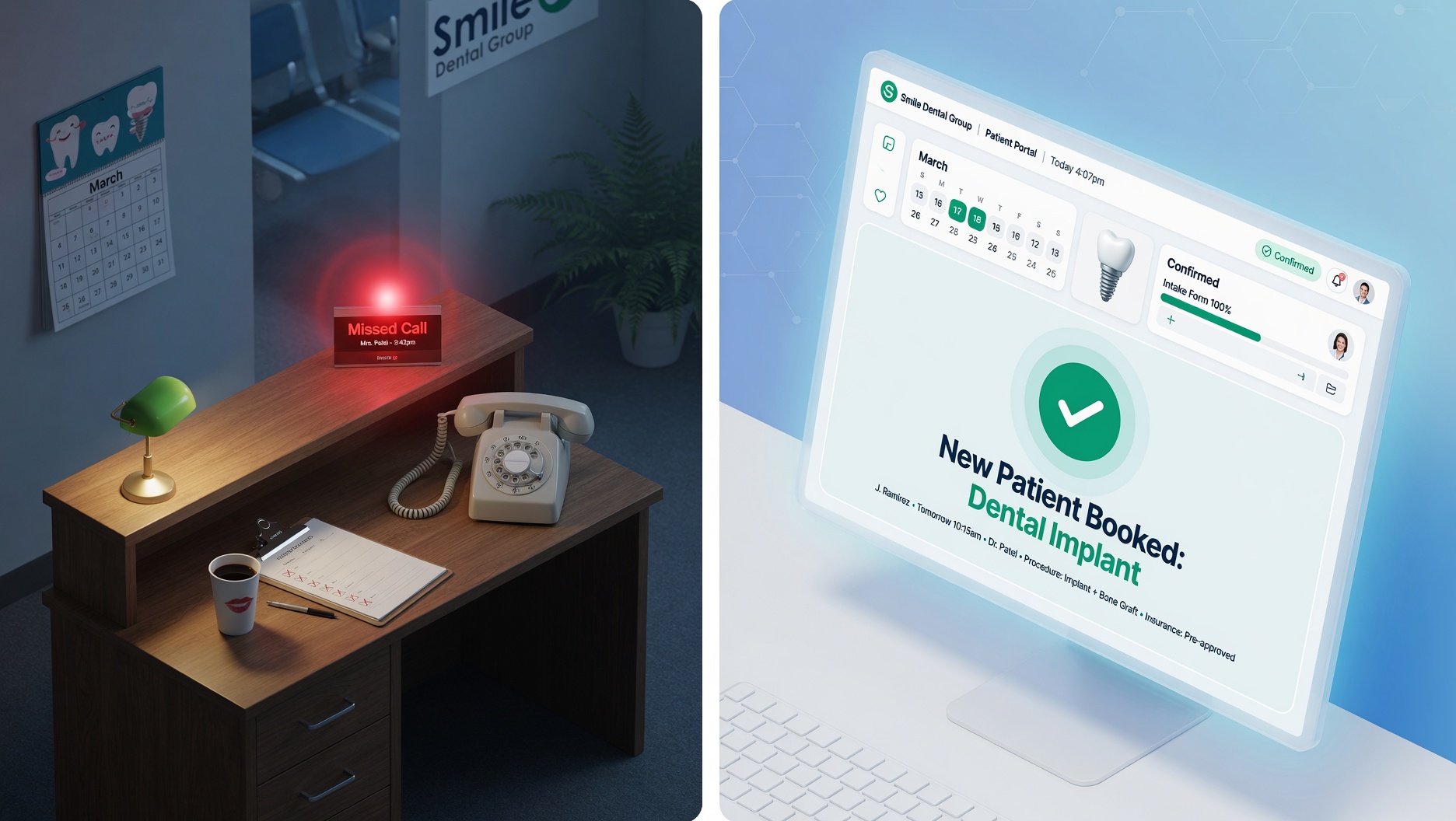
[Story Summary]
- Dental practices are currently facing a "fiscal squeeze" where rising operational costs and professional skepticism toward AI are leading to significant revenue leakage, specifically through missed patient calls and slow lead response.
- High interest rates and inflation (up 5% for dental supplies) have cooled consumer confidence, making patients more price-sensitive and slower to commit to large-scale, out-of-pocket dental investments.
- While clinical AI (diagnostics) faces high scrutiny regarding liability and trust, administrative AI (scheduling/follow-up) has proven to reduce no-shows by up to 50.7% and increase case acceptance by over 20%, offering a low-risk path to stabilizing practice margins during a period of reduced patient demand.
[What it means for practice owners]
- Immediate Revenue Capture: With 30–38% of inbound calls going unanswered, owners are losing an estimated $8,500/month in near-term revenue. Implementing 24/7 AI agents captures the "now" demand that currently evaporates when the front desk is busy or the office is closed.
- Protection of High-Value Cases: Patients seeking elective work (implants, Invisalign) are currently "financing-first" shoppers. AI tools that provide instant follow-up with financing information and annotated imaging explanations address patient hesitation at the moment of peak intent, preventing them from price-shopping at a competitor.
- Staff Optimization, Not Replacement: In a tight labor market where hygienist and front-desk wages are spiking, AI serves as a "shield," handling the repetitive 65% of calls related to routine scheduling so your high-cost human talent can focus on high-value case presentation and patient relationships.
[Story]
The Sources of Skepticism
Dental professionals have watched technology cycles come and go. Many remain wary of AI for good reason. A January 2026 survey by Oral Health magazine of practicing Canadian dentists found that 55% did not use AI tools for any administrative tasks, while only 11% were actively using them. The top barrier cited was lack of education and training. Similar patterns appear in U.S. and U.K. data. The British Dental Association’s 2025 Technology Adoption Survey showed that while 78% of practices used at least one AI tool, 41% of practitioners over age 50 expressed skepticism about its benefits. Hygienists surveyed by the American Dental Hygienists’ Association reported that half felt their practices were not at all prepared for AI, with cybersecurity and inaccuracy each cited as top concerns by 51.7%.
Clinicians worry about treatment-planning accuracy, liability if an algorithm errs, and whether patient trust will erode. HIPAA compliance adds another layer. Any AI system touching protected health information must have a signed business associate agreement; without it, practices risk fines and breaches. Past experiences with clunky chatbots that misfired on scheduling or gave generic answers have left teams jaded. The fear that AI will eventually replace front-office staff or dilute the human touch runs deep. These concerns are not abstract. They reflect real risks around data privacy, explainability, and integration with legacy practice-management systems that still dominate many offices.
The Daily Revenue Leak
Yet skepticism becomes expensive when it blocks tools that address what humans literally cannot do: respond instantly, consistently, and around the clock. Industry estimates, repeated across multiple dental operations reports, put the share of inbound calls missed by practices during business hours at 30-38%. Nearly 80% of those calls concern appointment scheduling; roughly 65% come from potential new patients. Only 14% of callers who reach voicemail leave a message. They simply move on.
The math is unforgiving. Multiple analyses peg the immediate first-year revenue value of a single new-patient call at roughly $850. Lifetime value estimates range from $4,000 to $8,000, depending on treatment mix. Practices that miss even ten new-patient calls a month are forgoing $8,500 in near-term revenue; over a year that compounds to six figures. One widely cited benchmark places average annual losses from missed calls alone between $100,000 and $150,000 per practice. Add slow responses to web forms and after-hours inquiries –periods when patient intent peaks but the office is dark – and the leakage widens. Harvard Business Review’s landmark study on online sales leads, still the benchmark cited in dental marketing analyses, found that companies responding within five minutes were 21 times more likely to qualify a lead than those waiting 30 minutes. Average response time across businesses was 42 hours. In dentistry, where elective procedures require rapid trust-building, those hours are decisive.
Headwinds in the Chair
The problem is magnified by current economics. The American Dental Association’s Health Policy Institute reported in October 2025 that practices continue to feel a “fiscal squeeze” from rising prices and lower demand for care. Two-thirds of dentists had raised fees since the start of the year, with practice prices climbing faster than inflation. Economic confidence among dentists remained stable but well below late-2024 peaks. Patients are noticeably more cautious with elective and cosmetic work—implants, Invisalign, veneers, and comprehensive restorative plans—that often fall outside insurance coverage. Financing questions surface earlier in the conversation. Patient acquisition costs have climbed; every lost lead or delayed follow-up therefore carries heavier weight. Unscheduled treatment backlogs average $2.4 million per practice according to DSO benchmarks, yet front desks remain overloaded with routine calls, reminders, and reactivations that pull staff away from high-value patient interaction.
The Tools That Already Work
The practical applications of AI in the revenue cycle do not ask teams to trust black-box diagnostics or surrender clinical control. They handle speed-to-lead, after-hours response, basic lead qualification, missed-call recovery, consistent follow-up, and patient reactivation – then hand off complex or sensitive matters to humans. HIPAA-compliant AI agent systems answer phones 24/7, confirm insurance basics, book appointments directly into the practice-management software, and escalate financing or clinical questions to the treatment coordinator. Automated follow-up sequences send treatment summaries, annotated imaging explanations, and financing prompts at timed intervals. In one reported multi-location group of seven clinics, an AI-driven follow-up system lifted high-value case acceptance (crowns, implants, periodontal treatment) by 22% over 12 weeks while cutting call-center volume by 31%. A larger DSO network saw abandoned treatment plans drop 25% and overall case acceptance rise 18% after implementing centralized AI outreach. Peer-reviewed work in primary-care settings using AI-powered no-show prediction and automated reminders achieved a 50.7% reduction in no-show rates. Dental-specific case studies have reported even steeper drops when AI appointment agents combine reminders with real-time rescheduling.
These systems do not replace the front desk; they shield it. Staff spend fewer hours chasing no-shows or repeating the same insurance-verification script and more time closing cases and building relationships.
A Better Question for Leaders
The real question is therefore not whether practices trust AI to replace their team. It is where the team is already losing revenue because humans cannot respond instantly, consistently, and 24/7. Speed-to-lead, after-hours availability, systematic follow-up, and low-friction scheduling are not futuristic luxuries; they are operational necessities in a market where media costs are rising and patient hesitation is real. Practices that treat administrative AI as a support layer – trained on their own protocols, compliant with HIPAA, and designed to escalate to humans – capture demand that would otherwise evaporate.
Coda
In the end, the quietest losses are the ones that never appear on a monthly P&L as line items. They show up as lighter schedules, slower growth, and the nagging sense that demand exists but never quite reaches the chair. The dental practices that separate legitimate clinical caution from administrative opportunity will not only protect revenue, they will turn every ring of the phone, every web-form submission, and every after-hours inquiry into a booked chair and a lasting patient relationship. The technology is already here. The only remaining variable is whether skepticism will let it in.
Sources
- Oral Health Group, “Why most dental practices are still on the fence about AI,” January 14, 2026, https://www.oralhealthgroup.com/features/why-most-dental-practices-are-still-on-the-fence-about-ai/ American Dental Association News, “‘Fiscal squeeze’ on dental practices continues,” October 1, 2025, https://adanews.ada.org/ada-news/2025/october/fiscal-squeeze-on-dental-practices-continues/
- Dimensions of Dental Hygiene, “Artificial Intelligence Reshapes the Future of Dentistry,” September 16, 2025, https://dimensionsofdentalhygiene.com/article/artificial-intelligence-reshapes-the-future-of-dentistry/
- Resonate AI, “18 Missed Calls in Dental Practices Statistics,” accessed 2026, https://www.resonateapp.com/resources/missed-calls-dental-practices-statistics (aggregating industry benchmarks)
- JMIR Formative Research, “Real-Time Analytics and AI for Managing No-Show Appointments in Primary Health Care in the United Arab Emirates: Before-and-After Study,” January 2025, https://formative.jmir.org/2025/1/e64936
- ConversAI Labs, “AI-Powered Patient Recall: How Dental Practices Recover $150K+ in Missed Revenue,” December 1, 2025, https://www.conversailabs.com/blog/ai-powered-patient-recall-how-dental-practices-recover-dollar150k-in-missed-revenue (vendor-reported case studies)
- California Dental Association, “AI in dentistry: What are the HIPAA violation risks?,” August 27, 2025, https://www.cda.org/newsroom/endorsed-services/ai-in-dentistry-what-are-the-hipaa-violation-risks/