
[Story Summary]
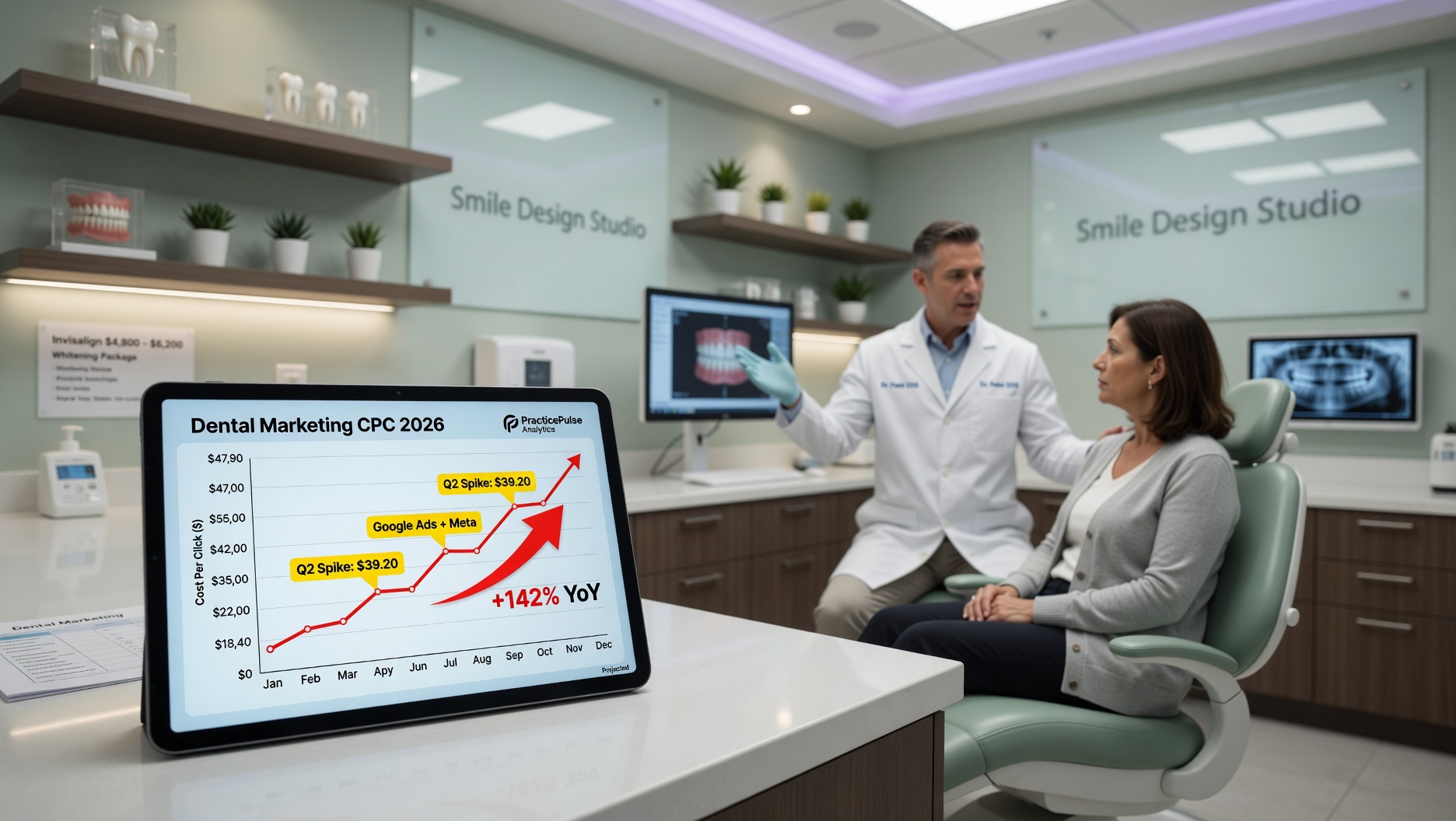
- Dental Google Ads costs have surged 10-15% in 2026, with high-intent keywords like "dental implants" reaching $12-$25 per click, signaling the end of low-cost digital patient acquisition.
- While consumer confidence in routine care remains steady, the rising cost of acquisition (CPA) is putting downward pressure on the profitability of elective procedures, likely leading to increased patient fees to offset marketing overhead.
- The healthcare sector is seeing an accelerated "digital arms race" where private-equity-backed DSOs use scale and AI-driven bidding to outcompete independent practices, further driving market consolidation and forcing a shift toward SEO and internal patient retention.
[What it means for practice owners]
- Margin Compression on Electives: With CPAs for implants and Invisalign now ranging from $150 to $400, your marketing ROI is shrinking. Owners must increase "case acceptance" rates at the chairside to justify the higher cost of getting the patient through the door.
- The Efficiency Gap: Practices failing to use HIPAA-compliant "Enhanced Conversions" are essentially subsidizing the auction for more tech-savvy competitors. Without precise tracking, your Google Ads spend is 20-30% less efficient than a modernized DSO's spend.
- Pivoting to "Offer Strength": Because searchers are clicking multiple ads before booking, your ad copy must move beyond "Quality Care" to specific, high-friction-reducing offers like "Same-Day Emergency Appointments" or "Transparent All-on-4 Pricing."
[Story]
For more than a decade, Google Ads served as the dental industry’s most reliable growth engine, delivering new-patient leads at costs that felt almost trivial compared with the lifetime value of a single implant or Invisalign case. That era has ended. In 2026, the same search queries that once yielded high-quality patients at $4-8 per click now routinely command $12-25, and in competitive urban markets, the price tag climbs even higher. The shift is not abstract; it is visible in monthly ad invoices, cost-per-acquisition reports, and the growing number of independent practices quietly scaling back paid-search budgets.
The mechanics are straightforward but brutal. Google Ads remains an auction. Every time a patient types “emergency dentist near me” or “dental implants [city],” dozens of bidders – solo practices, multi-location DSOs, corporate chains, and specialized implant providers – compete in real time. What has changed is the number and firepower of those bidders. Dental service organizations backed by private equity have poured tens of millions into digital marketing teams, automated bidding systems, and national campaigns that blanket local markets. A single DSO with fifty locations can outbid a solo practitioner on every high-value keyword without blinking, driving up the clearing price for everyone.
Competition from Corporate Scale Reshapes the Auction
Data from 2026 benchmarks show dental CPCs rising 10-15% year-over-year across most U.S. markets. Implant-related searches, which historically delivered the highest lifetime patient value, now average $12-25 per click – up from $8-20 in 2024. Emergency keywords remain relatively cheaper at $6-15 but still carry conversion rates that make them essential for cash-flow practices. Rural and suburban offices enjoy a temporary reprieve, with general-dentistry terms sometimes landing below $8, yet even those pockets are eroding as national players expand their geographic targeting.
The pressure is compounded by Google’s own platform evolution. The rollout of Search Generative Experience and AI Overviews has altered searcher behavior; more queries are answered directly on the results page, reducing the total pool of clicks available for paid ads. Advertisers chasing the remaining qualified traffic must bid more aggressively. At the same time, Google’s Smart Bidding and Performance Max campaigns – powered by machine learning that optimizes across search, display, YouTube, and Maps – have leveled the playing field for deep-pocketed operators while punishing those still managing manual bids or outdated keyword lists.
Quality Scores and Tracking Gaps Add Friction
Many practices have also discovered that their own campaigns are working against them. HIPAA-compliant call tracking limitations prevent Google from using full conversation data to train bidding algorithms, unlike in non-healthcare verticals. The result is inflated cost-per-lead metrics and more budget wasted on calls that never become booked appointments. Practices that have adopted Enhanced Conversions and precise offline conversion tracking report 20-30% better efficiency, yet the majority still lag, effectively subsidizing the auction for those who have upgraded.
Patient Expectations and Search Behavior Shift
On the demand side, patients themselves have grown savvier. The same high-intent searches that once converted at 15-20% now face longer consideration journeys fueled by online reviews, TikTok testimonials, and price-comparison tools. A patient researching Invisalign or same-day implants may click three or four ads before choosing a provider, multiplying the effective cost per acquisition. Industry benchmarks place the true cost of a new patient lead acquired via Google Ads between $150 and $400 in competitive markets – sometimes higher for elective cosmetic cases – erasing the easy math that once justified modest monthly budgets.
The human impact is already visible in dental operator forums and earnings calls. Solo and small-group practices describe “paying more for the same quality patient” while watching corporate neighbors dominate the top three ad slots. DSO executives, meanwhile, report that scaled ad spend remains profitable precisely because their centralized management and higher case-acceptance rates spread the elevated CPC across a larger revenue base. The consolidation wave that began years ago has now accelerated by the economics of digital patient acquisition.
What Happens Next
Google has shown no sign of easing the auction dynamics; its 2025-2026 policy updates around healthcare advertising and AI-driven bidding continue to reward data-rich, high-quality advertisers. Practices that treat Google Ads as a set-it-and-forget-it channel are quietly disappearing from the top of results pages. Those investing in offer strength – same-day emergency slots, transparent implant pricing, or compelling patient galleries – maintain better Quality Scores and lower effective costs. Yet the baseline reality has shifted: the days of cheap, scalable patient volume from search alone are over.
The story is not one of Google abandoning dentists. Paid search still drives roughly 35% of dental website traffic and remains the fastest path to new patients in saturated markets. It is simply no longer cheap. The auction has matured, the competitors have professionalized, and the platform itself has evolved. For dental-practice owners the message is clear: either master the new cost structure or diversify the patient-acquisition mix before the next 10-15% increase arrives.