
[Story Summary]
- High-level analysis reveals that psychological uncertainty – regarding pain, aesthetics, and recovery – is a more significant barrier to elective dental case acceptance than price alone, with average acceptance rates for high-value procedures stalling between 35% and 55%.
- This uncertainty dampens consumer spending power by shifting elective dentistry from a "desired self-improvement" to a "financial and physical risk," causing patients to defer high-ticket items like implants and clear aligners in favor of preserving liquidity during periods of economic volatility.
- For the dental sector and DSOs, failing to address this "uncertainty gap" results in lost high-margin revenue that is critical for offsetting stagnant insurance reimbursements and rising labor costs; however, practices utilizing 3D visualization and "tell-show-do" protocols are seeing significant lifts in treatment acceptance and same-store growth.
[What it means for practice owners]
- Revenue Optimization: Shifting your consultation focus from "financing options" to "outcome certainty" (via 3D simulations and trial-wear) can bridge the 20% gap between diagnosis and acceptance, potentially adding $150k–$300k in annual production for a standard GP practice without increasing marketing spend.
- Clinical Differentiation: In a 2026 market saturated with DSO competition, the "human layer" – specifically training treatment coordinators in empathy-based scripts (e.g., Feel-Felt-Found) – serves as a high-ROI defensive moat against lower-priced, high-volume competitors.
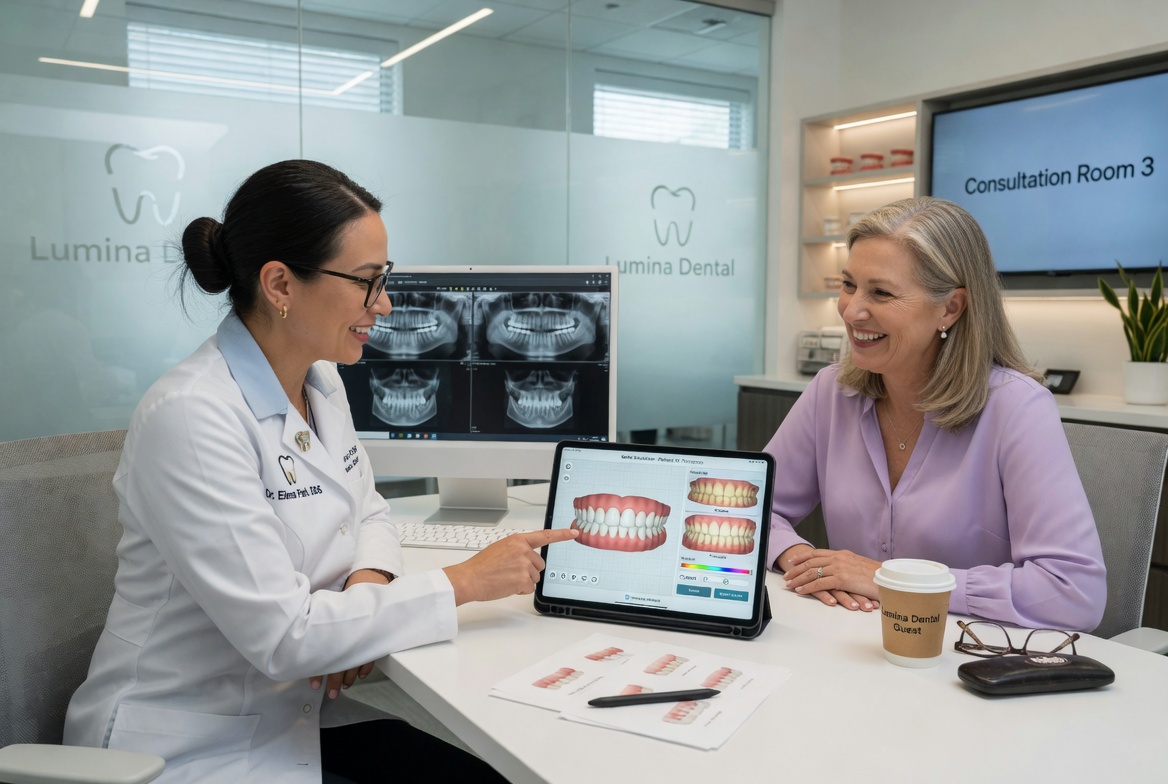
- Technology as a Sales Tool: Investing in chairside 3D simulation is no longer a clinical luxury but a conversion necessity; data indicates that visual "future-self" previews are the single most effective tool for neutralizing the "will it look fake?" objection.
[Story]
When Dr. Ramirez presents a $5,800 Invisalign plan to a 42-year-old marketing executive who hates her crowded smile, the patient nods politely, then hesitates. “It’s a lot of money,” she says. But after a few more questions, the real issue surfaces: “What if it doesn’t look natural on me? I’ve seen those celebrity smiles that look fake.”
Price, it turns out, was never the only objection. Uncertainty was.
Across dental offices from suburban solo practices to multi-location DSOs, this pattern repeats daily. Patients diagnosed with elective needs – single implants at $4,000-$6,500, full cosmetic veneers, or clear-aligner therapy – routinely voice cost concerns. Yet internal audits and consultant data consistently show the true blocker is fear of the unknown: Will the result match the preview? How much discomfort is realistic? What if something goes wrong? How long until I can eat normally or smile without self-consciousness?
The numbers tell the story. Industry benchmarks place overall dental case acceptance at roughly 50-60%, but elective procedures – those not covered by most insurance – fall to 35-55%. Top-performing practices, by contrast, routinely clear 70-85% by systematically dismantling uncertainty before price ever enters the conversation. The difference is not in better financing options. It is better information.
The Psychology of the Invisible Barrier
Uncertainty aversion is hard-wired. Behavioral research in healthcare decision-making shows patients routinely overestimate risks and underestimate benefits when outcomes feel abstract or personal fit is unclear. In elective dentistry the stakes feel especially personal: a new smile is visible every time the patient speaks or laughs. One misstep in perception and the patient walks away protecting both wallet and ego.
The CRTX Sales Coach, a dental practice guide for internal coaching, frames it simply: patients who ask questions are not rejecting treatment, they are asking for help clearing obstacles. “When a patient is asking questions, it shows that they do want the treatment, but they have some sort of obstacle in their own life that they need help overcoming,” the Coach advises. Fear-based questions – “Is it going to hurt? Can I go back to work the same day?” – are rarely about price. They are about control.
Practices that ignore this dynamic watch elective revenue leak away. DSO executives tracking same-store growth have learned that even modest lifts in elective acceptance – 5-10% – flow straight to the bottom line because implants, aligners, and cosmetic services carry 50-70% contribution margins versus routine fillings or cleanings.
Tools That Turn the Unknown Into the Expected
Leading practices now treat uncertainty as a diagnosable condition with repeatable cures. The most effective antidote is the long-established “tell-show-do” protocol, updated for 2026 technology.
First, tell. Teams walk patients through every step in plain language: the digital scan that takes 60 seconds, the custom aligners arriving in two weeks, the mild pressure they will feel (not pain), the exact timeline for visible change. Vague assurances are replaced by specifics: “Most patients notice straighter teeth by tray four and finish eating normally within 48 hours of any attachment placement.”
Next, show. Digital smile design software, intraoral scanners, and 3-D outcome previews have become standard. One large DSO reported a 24-50% jump in Invisalign acceptance after installing chairside simulation tablets. Patients no longer imagine their future smile; they see it overlaid on their own face. Before-and-after galleries are curated not for glamour but for “people like me” – same age, same starting crowding, same skin tone.
Then, do – gently. Many offices now offer “preview appointments” where patients try on a single test aligner or view a printed model of their projected implant crown. The tactile experience collapses uncertainty faster than any brochure.
Empathy scripts add the human layer. CRTX's “feel-felt-found” framework is commonly taught in sales training sessions nationwide: “I understand how you feel. Many patients have felt the same way about committing to something visible every day. What they have found is that once we lock in the digital plan together, the results match the preview 95% of the time. And we stand behind it with our adjustment policy.”
Reframing the Conversation From Cost to Confidence
Price talk is deferred until uncertainty is neutralized. When the patient has already pictured the outcome and understood the process, the investment conversation shifts from “Can I afford this?” to “How do we make this fit?” Treatment coordinators trained in transparent financing – 0% options, in-house plans, third-party lenders – close more cases because the patient is already sold on the value.
Testimonials recorded on video (with permission) carry special weight because they address uncertainty directly: “I was terrified it would look obvious. Six months later my coworkers still ask what I did differently.” Social proof from real patients in the same community beats generic marketing every time.
Practices that systematize this approach report measurable gains. One Midwestern group practice lifted elective acceptance from 48% to 76% in 18 months simply by adding a 10-minute “uncertainty audit” to every consultation: three scripted questions that surface hidden fears before the fee is ever quoted.
What the Data Predicts for 2026 and Beyond
With consumer confidence still recovering from 2025’s interest-rate volatility, elective dental spending remains sensitive. Yet the procedures themselves – implants, aligners, whitening – continue to grow in demand as remote work keeps smiles on camera and patients in their 40s and 50s prioritize self-image. Practices that reduce uncertainty convert more of that latent demand; those that do not, patients delay or defect to competitors promising “worry-free” experiences.
The competitive edge is no longer the lowest price or the flashiest equipment. It is the ability to make the invisible visible and the uncertain feel inevitable—in the best possible way.