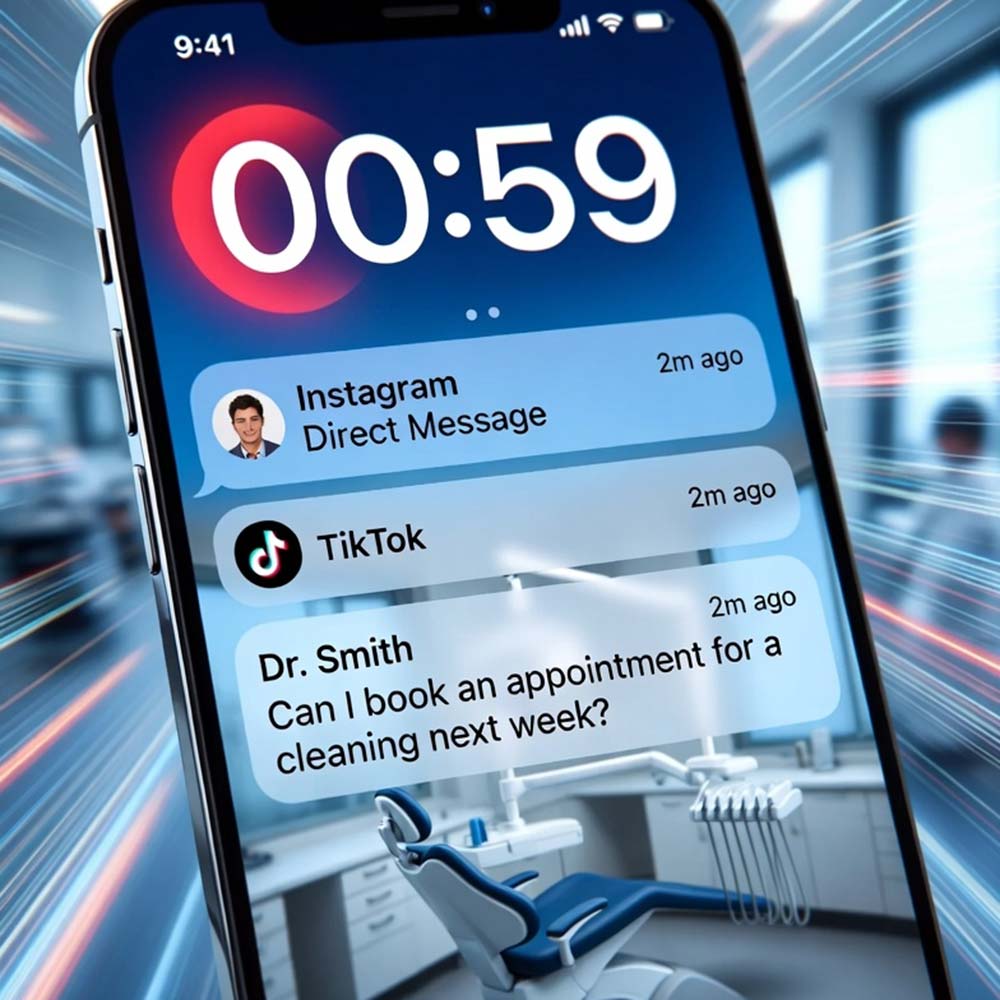
How has the typical U.S. dental patient’s buying behavior changed in the last 2–3 years?
Direct Answer:
In the last 2–3 years (2023–2025), U.S. shoppers have shifted toward on-demand, instant-gratification behaviors, expecting human-like, immediate responses 24/7, quick actions (like booking or starting processes instantly), and specific, thorough answers rather than generic ones, driven by the ubiquity of social media scrolls, instant messaging, and services like Amazon's same-day delivery and Grubhub's on-demand food.
If unmet (e.g., via voicemail or delays), they quickly move on to competitors. This "Amazon-fast" mindset, amplified by short-attention-span platforms like Instagram and TikTok, has made the first real, engaging reply the key to winning patients, often after hours, while economic pressures like inflation have made shoppers more value-conscious and selective.
Buyer Behavior Shift: U.S. consumers now demand instant, 24/7 responses, quick actions (e.g., booking), and personalized answers, influenced by social media scrolls, instant messaging, and on-demand services like Amazon/Grubhub—leading to short attention spans and after-hours decisions.
Why It Happened: Post-pandemic digital habits, tech rewards for speed, and economic pressures (e.g., inflation) have made "now" the norm; slow or generic replies cause quick abandonment to competitors.
Key Proof: 72% expect immediate service; social interactions up 20-30%; nearly half of bookings after hours; 32% abandon brands after one slow experience.
Dental Impact & Risks: New patients want seconds-level engagement via text/DM; existing ones expect seamless follow-ups. Not adapting leads to 17% annual churn, more no-shows, lost revenue, and missed leads as patients switch to responsive practices.
How to Adapt: Set <60s response tools, replace voicemail with text-backs, enable fast pre-qual/booking, use short videos for education, measure time-to-contact & bookings, and experiment safely.
Quick Start: DIY with free AI tools (e.g., OpenAI, ElevenLabs) or go turnkey with CRTX for HIPAA-compliant, 48-hour setup integrating your systems.
The core shift stems from a perfect storm of technology, culture, and post-pandemic habits. Pre-2023, shopping often involved planning, in-person visits, or tolerating delays. But accelerated by COVID-19's digital pivot, consumers normalized "now" as the default, reinforced by platforms that reward speed and seamlessness.
Social media's endless scroll trains users for micro-moments of satisfaction, where a like or DM response arrives in seconds, bleeding into expectations for all interactions.
On-demand services like Amazon (with Prime's near-instant delivery) and Grubhub (quick food via app) have conditioned shoppers to equate convenience with loyalty, reducing tolerance for friction like wait times or scripted replies.
This creates a low-attention economy: attention spans average 8 seconds (down from 12 in 2000, per recent studies), so vague or slow responses lead to abandonment. In an always-on world, after-hours inquiries spike, as shoppers browse and decide outside traditional business hours, expecting 24/7 engagement.
Economically, lingering inflation (CPI at roughly 2.7% in mid-2025) pushes value-seeking, but without sacrificing speed. Shoppers splurge selectively while trading down elsewhere, demanding instant proof of value.
The shift to instant-gratification expectations has forced dental practices to rethink interactions: new patients demand seconds-level responses, 24/7 access, and immediate actions like booking or pre-qualification via text/DM, while existing patients expect seamless rescheduling, quick answers, and personalized follow-ups to maintain loyalty.
Not adopting solutions (e.g., AI-driven engagement tools) leads to higher churn—losing up to 17% of patients annually—missed new acquisitions, increased no-shows, and revenue drops, as patients switch to more responsive competitors in an "instant everything" era.
1) Establish instant response across channels
2) Enable frictionless actions and pre-qualification
3) Leverage short streams for proof and education
4) Publish and measure your on-demand promise
DIY vs Comprehensive
You can DIY these changes using accessible AI tools: Start with LLMs like OpenAI, Claude, Gemini, or Grok for chat/text agents; add voice synthesis from ElevenLabs for phone handling; and integrate simple routing via Zapier or Twilio for channels like SMS and DMs. Layer in short videos with free tools like CapCut, set up basic SLAs in your CRM (e.g., Hubspot or HighLevel), and use open-source scripts for pre-qualification flows. It's feasible but requires piecing together components, manually ensuring HIPAA compliance, and ongoing tweaks for reliability.
Or you can sign up for CRTX, which offers everything in a turnkey solution that can go live in 48 hours, is HIPAA-compliant, easy for your staff to use, and integrates with your existing phone, calendar, and PMS. CRTX handles instant responses across channels, pre-qualifies leads, books appointments (directly or via links), nurtures with drips, and escalates urgents—delivering measurable outcomes like more bookings and hours saved, all while working alongside your team. Hire Your CRTX Agents at crtxagent.com/start.
Stats drawn from 2024–2025 reports for recency. McKinsey and Deloitte for economic shifts; Exploding Topics and Wyzowl for social/digital trends; PwC/Salesforce for gratification demands; Grubhub-specific for on-demand examples. ADA HPI, 3Shape, Curve Dental, PubMed/PMC, Arini, ResearchGate, PracticeNumbers, Etactics, DentalIntel, Zocdoc (cross-referenced), Planet DDS.