
[Story Summary]
- Sophisticated lead-generation networks are using clickbait "free dental implant" content to exploit Google’s advertising ecosystem, funneling low-quality inquiries to legitimate dental practices and inflating marketing costs.
- This phenomenon creates a "trust deficit" among consumers; as patients realize "government grants" for implants are largely nonexistent, they may become cynical toward all digital dental advertising, leading to delayed treatment and decreased confidence in out-of-pocket healthcare investments.
- For the healthcare sector, this trend highlights a critical vulnerability in automated ad platforms: DSOs and independent practices are essentially subsidizing the revenue of third-party arbitrage sites. This necessitates a shift in digital strategy, focusing on tighter "negative keyword" lists and a retreat from the broader Google Display Network toward more high-intent, branded search.
[What it means for practice owners]
- Increased Customer Acquisition Cost (CAC): Your marketing budget is likely being bled by $15–$35 "phantom clicks" from users preconditioned to expect free services, effectively lowering your ROI on high-ticket items like All-on-4 or implants.
- Operational Friction: Front-desk labor is being diverted to "de-programming" or disqualifying leads who are searching for nonexistent government subsidies, leading to staff burnout and missed opportunities with high-intent, qualified patients.
- Brand Protection Necessity: Practices must audit their Google Ads "Search Partners" and "Display Network" settings immediately to ensure their brand isn’t appearing alongside predatory "grant" articles that damage professional credibility.
[Story]
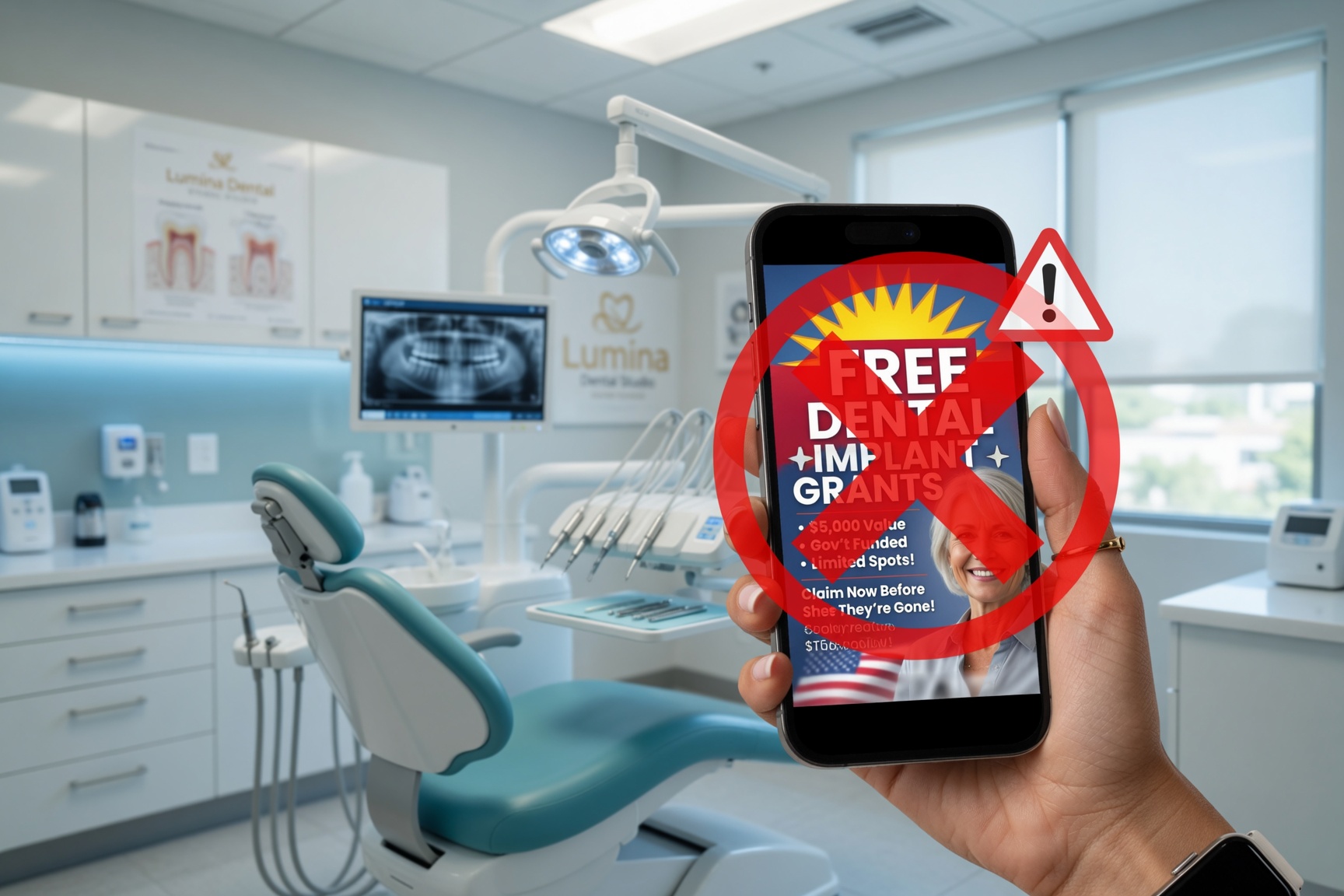
Dental offices across the country have grown accustomed to a peculiar daily ritual: the phone rings with yet another caller asking whether the practice is running a “free implant trial,” offering “government grants,” or participating in a “clinical study” that covers the full cost of All-on-4 or single-tooth replacements.
The inquiries are not random. They trace back to a sophisticated network of third-party websites and lead-generation firms that have mastered the mechanics of Google’s advertising ecosystem. These sites publish articles and landing pages optimized for high-volume searches such as “free dental implants near me,” “dental implant grants,” or “low-cost implant clinical trials.” The content rarely makes outright false promises; instead, it frames itself as helpful “guides” or “resource lists” for seniors, low-income patients, or anyone struggling with tooth loss.
Once a searcher lands on one of these pages, Google’s Display Network or Search Partner placements do the rest. Legitimate dental practices that bid on implant-related keywords suddenly appear in banners or recommended links on the very site that primed the visitor with expectations of free care. A single click charges the practice – often $15 to $35 – while the third-party site earns AdSense revenue. In some cases, the sites capture contact information through quizzes or forms and resell the leads, or use click-to-call technology that routes calls directly to the practice’s number. The patient, convinced the practice itself advertised the grant, dials in, frustrated or hopeful.
The Economics of Phantom Grants
Dental implants remain almost universally classified as elective or cosmetic by Medicare, Medicaid, and most private insurers. The U.S. Department of Health and Human Services Office of Inspector General has repeatedly warned against fake healthcare-grant schemes. Yet the ads persist because the promise taps into genuine financial pain: a full-mouth restoration can exceed $20,000, and many Americans lack coverage. Scammers exploit that desperation without ever claiming to be the government or a licensed clinic. They simply host “informational” content and let Google’s algorithm connect the dots.
Marketing agencies serving implant-focused practices report the same pattern nationwide. One agency documented how arbitrage sites rank highly for affordability keywords, then monetize by placing ads on the very ad inventory dental offices pay to appear in. Practices running strong Google Ads campaigns suddenly see conversion rates drop and cost-per-lead rise because a growing share of traffic arrives preconditioned to demand free treatment. Negative-keyword lists now routinely include “free,” “grant,” “trial,” “government assistance,” and “clinical study” to blunt the bleed.
Inside the Call Center: A New Kind of Lead Fatigue
Front-desk teams describe the calls as polite but persistent. Callers often recite details from the misleading page: “It said I qualify for a grant if I’m over 60,” or “The ad mentioned a free first implant as part of a trial.” When told no such program exists, some become angry, believing the practice is withholding advertised benefits. Others hang up disappointed, further eroding trust in digital dental marketing overall.
Larger DSOs have begun tracking the volume. In high-search-volume markets, unqualified “grant” inquiries can consume 15 to 20 percent of inbound implant leads on certain days. Smaller independent offices, already stretched thin, report staff spending hours explaining insurance realities instead of scheduling paid consultations. The problem spikes in winter and early spring – months when patients search from home after reviewing year-end medical bills.
Google’s Incentives and Enforcement Gaps
Google has clear policies against misleading health claims in paid ads themselves. Yet the platform’s Display Network and AdSense program operate on a different standard: publishers are responsible for content, and Google profits from every impression and click. As long as the third-party sites avoid direct falsehoods – phrasing everything as “possible options” or “what to know about grants” – they remain in compliance. Industry insiders note that Google’s automated systems prioritize click volume and advertiser spend over deep intent analysis for high-value elective keywords. When practices complain, support responses often point to negative keywords or placement exclusions rather than systemic removal of the offending publishers.
Meta platforms have faced similar backlash for “free implant” Facebook ads that hijack practice names and images, but Google’s role is more structural. Its network powers the discovery layer for millions of health-related searches, creating a profit loop that third parties have learned to game.
Broader Ripple Effects on Elective Care
The steady drip of disappointed callers does more than waste time. It subtly shifts patient psychology. People who once viewed implants as a worthwhile investment after seeing real before-and-after stories now associate the entire category with scams. Some delay treatment altogether, allowing bone loss to worsen and future costs to climb. Others pivot to cheaper, less predictable alternatives or medical tourism, further fragmenting the domestic market for high-quality, full-fee cases.
For DSO executives managing dozens of locations, the issue underscores the need for tighter campaign hygiene. Independent owners, who often lack dedicated marketing teams, face the greatest exposure: every wasted click directly erodes the ROI that makes Google Ads viable for a $5,000-plus procedure.
What began as isolated complaints has become an industry-wide signal. Dental associations and marketing firms now routinely advise clients to treat “free,” “grant,” and “trial” phrases as red-flag exclusions rather than opportunities. Meanwhile, legitimate practices continue to compete on transparent financing, in-house payment plans, and clear value propositions – none of which rely on government largesse that does not exist.
The next chapter will likely hinge on whether Google tightens Display Network oversight or whether practices simply route around the problem by narrowing their keyword footprints and investing more in branded search and retargeting. Until then, the phones keep ringing with the same hopeful question: “Is this the office offering the free implants?”