
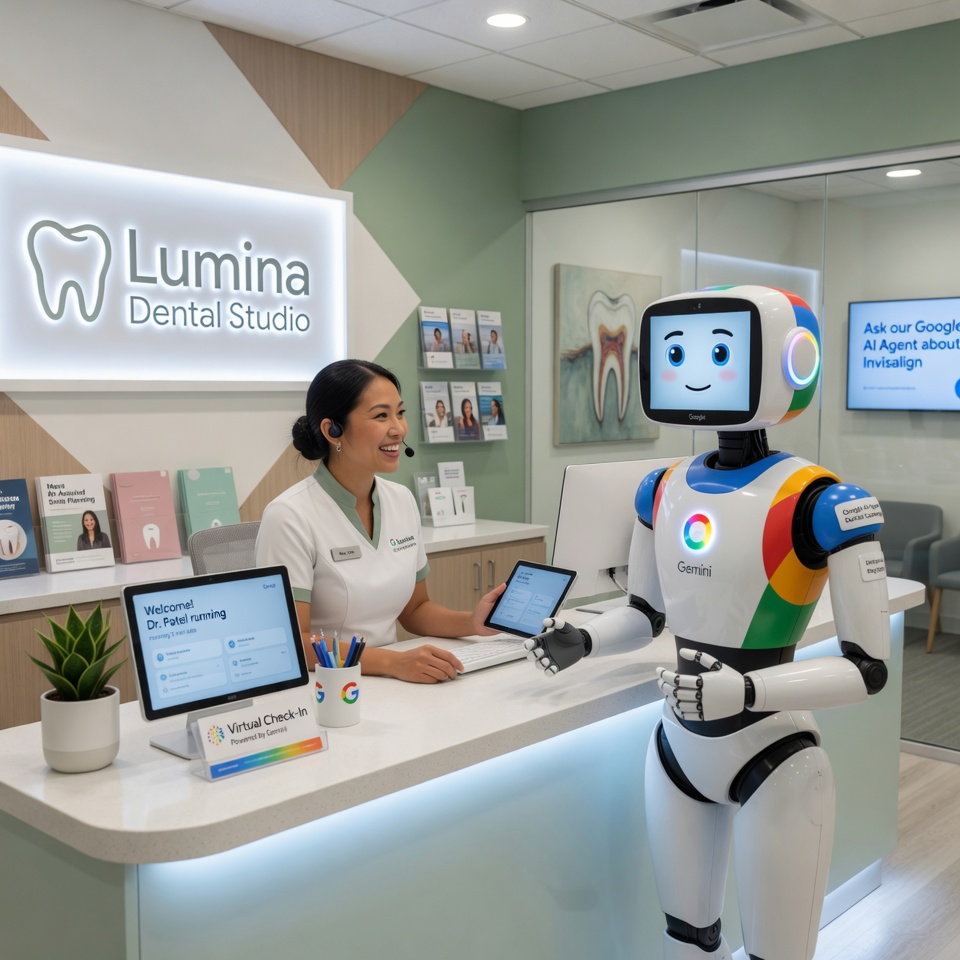
Autonomous AI in Search no longer waits for a query. It watches, compares, and alerts patients around the clock – turning passive browsers into proactive shoppers for elective care.
[Executive Summary]
- At Google I/O 2026 (its big show), the company replaced the 25-year-old search box with an intelligent AI interface powered by Gemini 3.5 Flash and introduced “information agents” that run 24/7, synthesizing data from reviews, pricing pages, clinical sites, and social posts.
- Patients can now instruct agents once –“track Invisalign costs near me under $4,000” or “alert me when implant specials drop in South Florida” – and receive push notifications with synthesized comparisons, no repeated searches required.
- Rollout begins this summer for Google AI Pro and Ultra subscribers in the U.S., then expands
- The shift moves dental marketing from click-driven SEO to agent-readable, structured data that agents summarize without ever sending traffic to your site.
[What it means for practice owners]
- Wait. Pause. Reread the above. This is a sea change.
- Patient acquisition costs will climb as agents filter out low-visibility practices before patients ever see your website or Google Business Profile.
- Elective procedures – implants, Invisalign, cosmetic veneers – face faster price transparency; agents already pull real-time financing offers and insurance coverage details, compressing the decision window from weeks to hours.
- DSOs with standardized online menus win; fragmented single-location sites lose because agents prioritize consistent, machine-readable data on outcomes, before-and-afters, and verified reviews.
- Insurance-driven volume may hold steady, but cash-pay cosmetic patients now arrive pre-sold or pre-rejected based on agent-curated comparisons, shifting front-desk time from education to closing.
- Regulatory scrutiny on health claims intensifies; agents flag inconsistencies faster than humans, forcing every practice to keep treatment pages surgically accurate or risk being omitted from summaries.
[Story]
Google announced the change on May 19 at I/O.
The old search box is gone.
In its place sits a dynamic, expanding field that accepts text, images, PDFs, and even open browser tabs. Type a question, and the system no longer returns ten blue links. It drops you into an interactive canvas where agents do the digging.
Liz Reid, who runs Search at Google, put it plainly: agents now “monitor the web around the clock on your behalf.”
One demo showed an agent tracking movie-ticket prices. Swap movies for “full-arch implants under $15k in Kansas City,” and the implication is immediate.
Patients set the goal once. The agent works while they sleep.
This is not another AI Overview tweak. Those were summaries. These are actors. They plan, cross-reference, and push alerts. They can compare three local practices across price, wait times, and patient ratings, sourced from multiple platforms. They explain trade-offs in plain language – “Practice A uses same-day loading but charges 12% more for financing.” No scroll. No clicks. Just the synthesized answer.
The hidden cost is speed. A patient who once spent two weeks researching now gets the short list in a single notification. Treatment-acceptance conversations that used to start with “I saw this online” now start with “My agent said your all-on-4 package is $1,200 higher than the DSO down the street.” Your website traffic may drop while inbound calls rise – only now the caller already knows your numbers.
For DSO operators the math is different.
Standardized pricing pages, structured schema markup, and verified Google reviews become mandatory table stakes. Agents favor clean, consistent data.
A single-location practice with a pretty site but spotty updates risks being invisible.
The agent simply skips it and surfaces the competitor that publishes real-time availability and transparent fees.
Front desks already feel the shift. Fewer callers ask “How much is Invisalign?” because the agent already told them.
More callers arrive ready to book or ready to negotiate.
The conversation moves upstream. Practices that once relied on broad PPC now need to feed agents the exact details patients will ask: financing partners, sedation options, same-day crown capability, five-year success rates.
The practical reality is simpler than it sounds.
Update your site with clear, structured sections on every elective service – price ranges, what’s included, what’s not, financing partners, and verified outcomes.
Keep Google Business Profiles current daily. Encourage verified reviews at the point of service. Agents reward freshness and specificity; vague “cosmetic dentistry” pages get filtered out.
None of this kills the need to market.
It just changes the marketing objective from visibility to credibility.
Patients will still call, but they arrive with agent-vetted short lists.
The practices that win are the ones whose data stands up to automated scrutiny.
The executive takeaway is blunt. Google did not improve search. It replaced the passive discovery model with active, persistent agents that represent your future patients. The practices that treat this as another marketing tweak will watch volume migrate to competitors whose digital presence is built for machines first and humans second. The ones that see it as a new patient-acquisition channel will feed agents clean data, sharpen their value propositions, and close more cases from better-qualified leads.
Your next move is not more ads. It is a one-hour audit of every page an agent might read. Make sure the numbers, the outcomes, and the proof are impossible to mis-summarize. Because starting this summer, patients are no longer searching. Their agents are.