With every vendor promising “answer immediately” and “never miss another call,” how should a dental practice choose an AI partner? And is it real to say that most practices will be running some kind of AI front office by 2026?
Direct Answer:
AI reception is no longer novel. It's a checkbox.
Patients already expect 24/7 access and quick replies.
Practices are missing a painful number of calls.
Small businesses and healthcare organizations are rolling AI into daily operations at a fast pace.
The real question is not, “Should we use AI?”
It’s, “Which model will actually increase new-patient appointments without blowing up our workflow?”
The good news: you can follow a simple, 90-day roadmap to get a real advantage over other practices in your area, without increasing ad spend.
Let’s ground this in numbers.
1. Patients are booking when you’re closed
Zocdoc’s national data and related analyses show that around 42–50% of U.S. appointments are booked outside normal business hours (5 p.m.–9 a.m.).
Self-scheduling tools see a big spike in bookings after hours, once patients can grab a spot on their phone, at their convenience.
If you’re depending on voicemail and next-day callbacks, you’re fighting patient behavior, not just competitors.
2. Dental practices are leaking money on missed calls
Studies on dental call patterns show that practices miss roughly 1 in 3 calls on average. Some estimate missed-call rates of 35–68%.
One industry review notes that nearly 80% of missed calls in a dental office are about scheduling, and only about 14% of new patients leave a voicemail when their call isn’t answered.
CPA and consulting analyses estimate dozens of potential new patients lost per month, often translating to thousands of dollars in missed revenue for an average practice.
So even a modest improvement in answered calls and conversion – without more marketing – moves the needle.
3. AI is moving from “nice to have” to normal
On the business side:
A U.S. Chamber of Commerce study found 58% of small businesses were using generative AI in 2025, up from 40% in 2024 and 23% in 2023.
A national SMB survey by Thryv showed AI adoption jumping from 39% in 2024 to 55% in 2025. 80% of those businesses say AI is essential to reach new customers.
Other surveys show that at least a quarter of small businesses have already integrated AI into daily operations, and over half are actively exploring it.
In healthcare:
Menlo Ventures reports that 22% of healthcare organizations have already implemented domain-specific AI tools, a 7X increase over 2024. Outpatient providers (which include many dental-like care settings) are at 18% and climbing.
AMA and hospital surveys show that AI is widely used for documentation, predictive tools, and operational efficiency. One 2024 AMA survey found that around two-thirds of physicians use AI tools, especially for clinical documentation.
Put those trends together and a conservative, practical forecast is:
Most dental practices will have at least one AI-powered front-office or patient-communication tool in place by the end of 2026.
Whether that’s a full AI receptionist, an AI web chat, or AI-assisted texting, this will be normal, not novel.
Over the past 12–18 months, more than a thousand companies have hung out a shingle:
“AI receptionist”
“Virtual front desk”
“Never miss another call”
“24/7 medical answering”
Plus, your phone provider, PMS, CRM, and chat vendor are all bolting on their own “AI assistant” buttons.
To a practice owner, everything blends together.
So the job of a leading-edge practice is not to memorize vendor names. It’s to use the right filters.
You can evaluate almost any AI reception solution with 4 simple questions:
1. Does this actually increase the number of new-patient appointments?
Look for:
A focus on new-patient flow, not just “call volume.”
Scripts and logic that handle:
Insurance basics
Price ranges and financing
Urgent vs. non-urgent cases
Cosmetic vs. functional needs
Reporting that shows:
Leads handled
Consults booked
Show rates
Hours saved
If the story stops at “we answered X calls,” you’re buying a switchboard, not a sales assistant.
2. Does it fit my world, or force a rebuild?
You want a “work beside” solution, not a replacement.
Ask:
Can I keep my current phone system and simply forward:
After-hours calls
No-answer / busy overflow on the new-patient line
Can it book into my PMS (Dentrix, Eaglesoft, Open Dental, etc.) or at least:
Set a confirmed hold
Send an online scheduling link to the patient
Keep my existing calendar as the source of truth
Is there a simple snippet to:
Capture website form submissions
Turn them into instant text conversations
Add web chat to my site
If the answer involves ripping out phones, migrating calendars, or retraining everyone on a heavy CRM, be cautious.
3. Does it understand dentistry, or just “small business”?
Most AI tools on the market are horizontal. They pitch:
Dental
HVAC
Pools
Med spas
Retail
Auto
All with the same engine.
Ask for proof that it knows dentistry:
“Show me real transcripts for:
Implant and full-arch leads
Emergencies
Cosmetic consultations
Insurance questions
Financing objections”
“How does the agent respond when someone says:
‘I’m in pain today’
‘Do you take my plan?’
‘How much are implants?’
‘I no-showed last time and I’m embarrassed’”
If all the examples are generic – “We handle your request” – you know what you’re looking at.
4. How does it bring a person in (i.e., alert your team), and how do I see what happened?
The handoff is often where practices win or lose.
Ask:
“When does the AI alert us to get involved?”
Upset, confused, or frustrated patients
Pain and emergencies
Complex insurance/financing
High-value cosmetic or full-arch leads
“What does my team see on their side?”
A single timeline per patient, with calls, texts, forms, and chats in one place
Clear flags for VIPs and urgent cases
A simple daily or weekly email summarizing:
Who booked
Who needs follow-up
How many hours did we save
If you can’t see the story, you can’t manage it.
Here is a simple plan you can follow, step by step.
Phase 1: Baseline your leak (Week 1–2)
Pull the last 90 days of:
Total incoming calls
Missed call rate (and times of day with the worst misses)
New-patient inquiries per month (by channel)
New-patient consults booked and show rate
Time-to-first-response for:
Web forms
Ad leads
Social DMs
Then write down, in plain language:
“We miss about ___% of our calls.”
“We book about ___ new-patient consults per month; ___% show.”
“Our average time-to-first-response for web leads is ___ hours.”
This is your starting line.
Phase 2: Design your AI + human coverage model (Week 2–3)
You do not want AI to take over everything. You want it to cover the gaps and reduce the grind.
Decide:
Where AI leads
After-hours new-patient line
No-answer / busy overflow
First response to website forms
Website chat and basic FAQs
“Call me back” or “I have a quick question” interactions
Where humans lead
Existing-patient calls during business hours
Complex clinical conversations
Edge-case insurance and financing
VIP cases, full-arch closes, or emotionally charged situations
Put this in a one-page policy so your team is clear. Then look for a vendor that can match it.
Phase 3: Shortlist and pilot (Week 3–6)
From your inbox and the market, pick 2–3 options that:
Work with your current phone system
Connect to your PMS or scheduling system
Show real dental transcripts
Offer month-to-month terms
Then define a tight pilot:
Scope:
New-patient line only
After-hours + no-answer
Duration:
6–8 weeks
Measured against:
Missed calls → reduced
New-patient consults booked → increased
After-hours bookings → increased
Staff phone time → reduced
Keep your reporting simple. One page, weekly.
Phase 4: Expand to omnichannel (Week 6–10)
If the pilot works, expand coverage:
Turn on form-to-text:
Every new web form gets an instant SMS response.
The AI continues the conversation in real time.
Add web chat:
Same brain as the phone agent.
Same booking rules.
Bring in social DMs if you have strong traffic there:
YouTube
Non-negotiables:
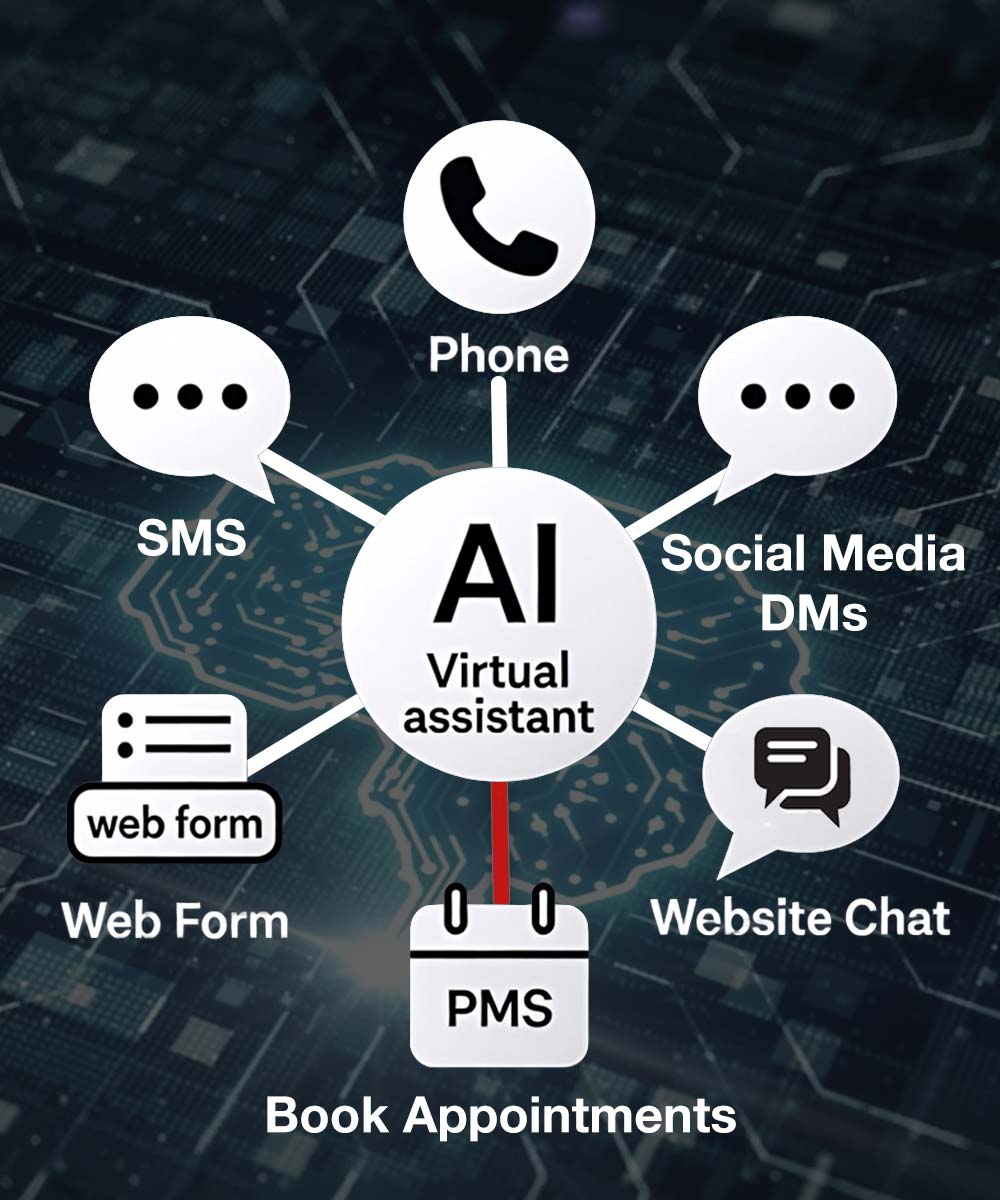
All channels feed into the same patient timeline.
The AI can either:
Book directly into your PMS
Or set a confirmed hold and send an online scheduling link, so your calendar remains the source of truth.
Your goal here is not “more touchpoints.” Your goal is “one brain, many doors.”
Phase 5: Use AI to grow revenue without more ads (Week 10–13)
Once coverage is in place, you have three low-cost levers.
A. Recover missed opportunities
Use outbound call + SMS follow-up rules:
Recent unconnected leads
1–2 touch attempts per day
Respect quiet hours
Stop on book/human/opt-out
This alone often recovers a surprising volume of consults from leads you already paid for.
B. Improve conversion on existing traffic
Tighten your qualification script:
A short set of questions about:
Timing
Insurance/payment
Type of problem or interest
Readiness and budget
Teach the AI to answer basic pricing and financing questions in ranges, and to bring a person in when nuance is needed.
C. Reduce no-shows
Confirm and remind through the same channel that booked the visit.
Make sure reminders are not just “You have an appointment,” but “We’re ready to see you for ___ at ___; reply if you need to update anything.”
At this point, you are not chasing more impressions. You’re simply plugging the holes in a funnel you already own.
You can drop these straight into emails, team meetings, or vendor calls.
A. To your team: why we’re doing this
“We’re not installing AI to replace anyone.
We’re installing it to stop losing patients when we’re busy or closed.
The goal is simple: answer in seconds, book more of the right patients, and bring a person in when that will get a better result.
Your jobs become more focused on higher-value conversations, not chasing voicemails.”
B. To vendors: cutting through the demo
Use these three questions:
“Show me real transcripts of your system handling:
Implant or full-arch leads
Emergencies
Insurance and financing questions.”
“Walk me through what happens when:
A new patient calls at 7:30 p.m.
A web lead fills out a form at 11:00 p.m.
A patient texts to cancel tomorrow’s appointment.”
“How does this fit with what we already use?
Our phones
Our PMS
Our current scheduling process”
If they can’t answer these clearly and concretely, move on.
C. The question I get all the time:
“How is CRTX different from all the other overnight organizations?”
Here’s the answer I use. You can adapt the structure for any comparison.
“Most of the new tools on the market answer phones or chats.
CRTX is a virtual sales agent built only for dentistry that finishes the job across every channel and works beside our existing phones and calendar.”
Then, the quick expansion:
“Generic tools are usually AI wrappers that bolt onto many verticals—HVAC, retail, med spa, dental—with light scripts.
CRTX is dental-specific. It’s trained on 1,000,000+ real dental cases and built around dental workflows, objections, and edge cases.
It doesn’t just answer calls. It:
Responds in seconds across phone, text, forms, chat, and DMs.
Pre-qualifies on insurance, pricing, and financing.
Books into your PMS where permitted, or sets a confirmed hold and sends an online scheduling link.
Brings a person in for VIPs, urgencies, and complex situations.
Finally, it shows you the whole story in one place: who called, who booked, who needs follow-up, and how many hours you saved, so you see real movement in kept new-patient appointments, not just activity.”
You can shorten that to:
“Other tools answer calls.
CRTX is a dental-trained sales agent that answers in seconds, finishes the job across every channel, and brings your team in when that will convert better.”
If you want a simple test before you commit to a full rollout, try this:
14-Day After-Hours Audit
For the next 14 days, track:
How many calls you get after hours
How many go to voicemail
How many voicemails you actually return within 24 hours
How many of those calls turn into booked, and kept, appointments
Then ask one question:
“If we had answered these in seconds, with the ability to book or text back in real time, how many more new patients would we have seen?”
That number is your “AI budget” without touching ad spend.
Whether you choose CRTX or another partner, hold the system accountable to a short list of metrics:
Leads handled per week (by channel)
Missed call rate before vs. after
New-patient consults booked (daytime vs. after-hours)
Show rate on those consults
Average time-to-first-response for web and ad leads
Estimated team hours saved on phones and basic follow-up
If these numbers move in the right direction, keep going. If they don’t, change vendors or change the rules.
This Brainwaves article is vendor-agnostic by design. Any partner that follows this playbook will put your practice in a stronger position by 2026.
CRTX exists as the “ready button” for this model:
Dental-specific
Answers in seconds across every channel
Works beside your current phones and calendar
Focuses on kept new-patient appointments and clear reporting
If you’d rather hire a system that already runs this strategy out of the box, you know where I’m biased.